


What Hidden Costs Do Buyers Overlook When Purchasing in Denton County Neighborhoods With MUD or PID Taxes?
By Bob McCranie | HomeSmart Stars – Texas Pride Realty Group
You found a beautiful home in a newer Denton County neighborhood. The price looks right, the finishes are stunning, and the community amenities are impressive. Then you see the monthly payment your lender calculated and it's $300 more than you expected. What happened?
In many cases, the answer is a Municipal Utility District — or MUD — layered on top of the standard property tax rate. MUD taxes and their close cousins, Public Improvement Districts (PIDs), are among the most misunderstood costs in Denton TX real estate, and they catch buyers off guard more often than almost anything else in the transaction. Let me explain exactly what they are, how they affect your payment, and what you need to verify before you close.
What Is a MUD Tax — and Why Does It Exist?
The Basics
A Municipal Utility District is a special-purpose governmental entity created under Texas law to finance the infrastructure costs of developing land that isn't yet served by city utilities. When a developer builds a master-planned community on raw land in Denton County, they typically don't have city water, sewer, roads, or drainage systems already in place. A MUD allows the developer to issue bonds to finance that infrastructure, and homeowners within the district repay those bonds through an additional property tax assessment on top of every other tax they pay.
In plain terms: the developer built the infrastructure, borrowed money to do it, and you — as the homebuyer — are paying back that loan through your tax bill every year you own the home.
What Is a PID?
A Public Improvement District works similarly but is typically imposed by a city rather than created as an independent taxing entity. PIDs are often used to fund amenity centers, landscaping, entry features, and other community improvements that go beyond basic utility infrastructure. Some newer Denton County communities carry both a MUD and a PID — meaning two additional tax layers on top of the standard rate.
How Much Do MUD and PID Taxes Actually Add?
This is where buyers get surprised, because the numbers can be significant. Here's a realistic example:
A home in a newer master-planned community in northern Denton County might carry:
-
- Denton County base tax rate: ~0.22%
- Local city or ETJ rate: ~0.40–0.55%
- School district rate: ~1.10–1.30%
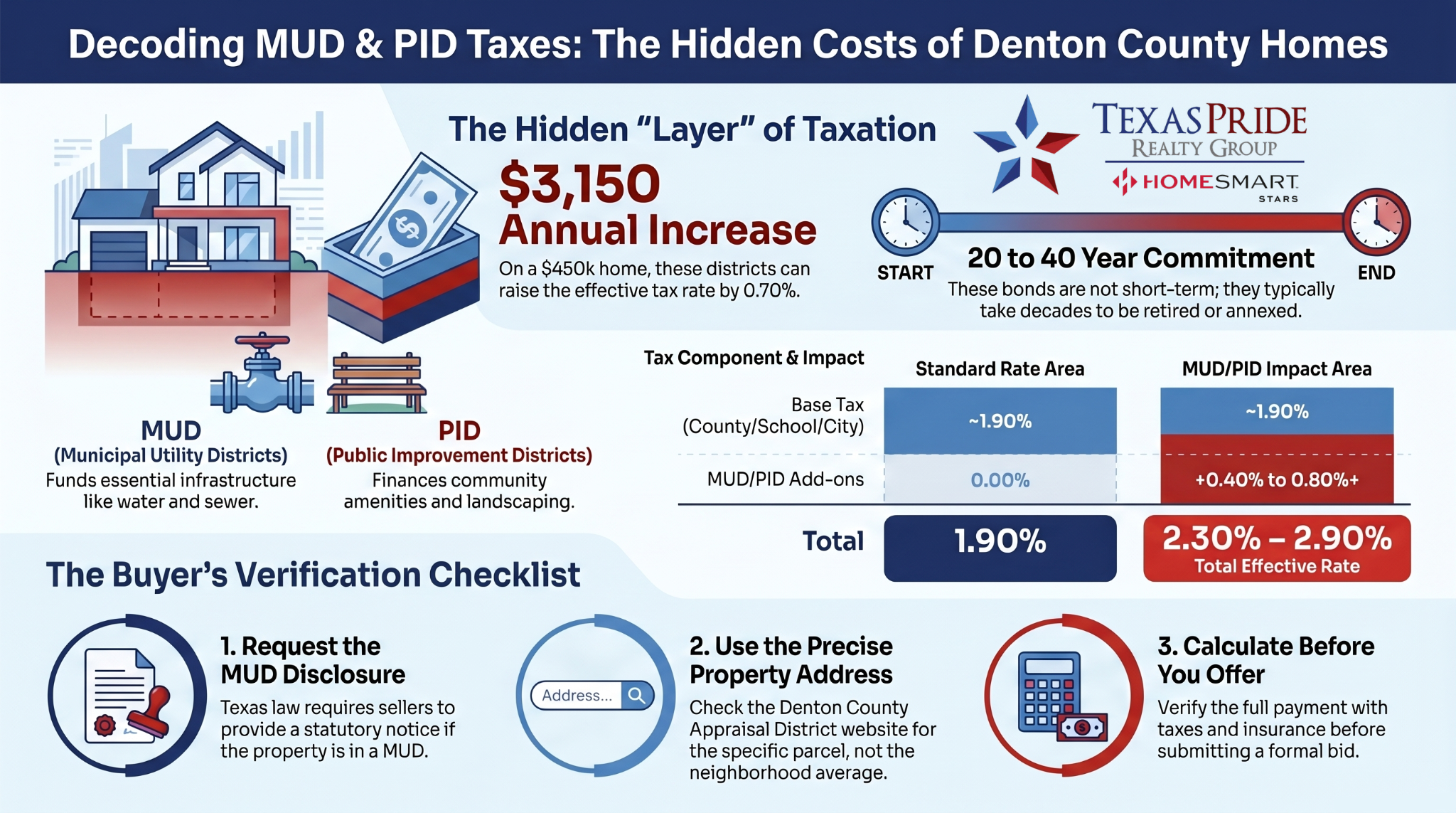
- MUD rate: ~0.40–0.80%
- PID assessment: $500–$1,500 annually (sometimes fixed, sometimes rate-based)
Total effective rate: 2.20% to 2.90%
On a $450,000 home, the difference between a 1.90% effective rate and a 2.60% effective rate is $3,150 per year — or $262 per month added to your payment. That's material, and it's the exact number that many buyers don't discover until their lender runs the final payment estimate using the actual tax record for that address.
The Denton TX homes for sale database is a great starting point for your search, but always verify the full tax rate for any specific address before making an offer — not just the county average.
When Do MUD Taxes Go Away?
This is the question buyers most frequently ask — and the answer is: eventually, but not on a predictable timeline.
MUD bonds are retired when the debt is paid off, at which point the MUD can be dissolved or annexed by the city. In practice, this can take 20 to 40 years from the initial development. Some MUDs are eventually annexed by cities with lower combined tax rates, which can reduce the total burden. Others persist for decades.
The key point: when you buy into a MUD community, you should plan on that additional tax being part of your cost of ownership for the foreseeable future — not something that disappears in five years.
What Buyers Must Do Before Closing in a MUD or PID Community
Bob McCranie at HomeSmart Stars – Texas Pride Realty Group has been helping buyers navigate Denton TX real estate since 2003. With over 1,150 homes sold, Bob's team treats MUD and PID verification as a non-negotiable step in every transaction involving a newer Denton County community.
"I've seen buyers get their final payment disclosure and be genuinely shocked by the tax bill," Bob says. "The solution is simple — verify the full tax rate for the specific property address before you fall in love with a home. Not the neighborhood average. The exact parcel. Rates can vary even within the same subdivision if phase boundaries align with different MUD districts."
Here's the verification checklist Bob's team uses:
Request the MUD Disclosure Notice. Texas law requires sellers to disclose if a property is within a MUD and provide a statutory notice form. If you don't receive one, ask specifically.
Look up the actual tax rate on the Denton County Appraisal District website. Use the specific property address, not a neighborhood estimate. Pull the most recent tax records and add up every line item.
Ask about PID assessments separately. PIDs sometimes appear as a line on the tax bill, sometimes as a separate annual assessment. Confirm which applies to the specific address.
Calculate the full payment with taxes and insurance before submitting an offer. Use the verified tax rate, not a rounded estimate, so there are no surprises at closing.
Which Denton County Communities Are Most Likely to Have MUD or PID Taxes?
As a general rule, newer master-planned communities built on previously undeveloped land — particularly in the growth corridors north and west of the city of Denton, in Aubrey, Little Elm, Justin, and parts of Northlake — are the most likely to carry MUD or PID assessments.
More established communities in Corinth, Highland Village, Flower Mound, and the city of Denton proper are less likely to have active MUD districts, though PIDs can exist in some areas. Always verify — even in established communities.
If you're considering Denton County new construction or exploring homes on acreage in outer growth areas, MUD and PID due diligence is especially important.
The Bottom Line
MUD and PID taxes are not inherently bad — they fund real infrastructure that makes communities functional and attractive. But they are a cost that buyers need to understand and budget for before they commit. The difference between a well-informed buyer and a surprised one is simply doing the homework on the full tax picture before falling in love with an address.
With 45 Google 5-star reviews and a team that has navigated hundreds of Denton County transactions, Bob McCranie at HomeSmart Stars – Texas Pride Realty Group makes sure every buyer understands the complete cost of ownership — not just the purchase price — before they sign anything.
Contact Bob McCranie at HomeSmart Stars – Texas Pride Realty Group | 972-754-0582 | www.TexasPrideRealty.com for a FREE 2026 Market Strategy Session.