You know the house isn't working financially. You've known for months, maybe over a year. But you keep waiting.
Waiting for income to increase. Waiting for expenses to stabilize. Waiting for something to change. Waiting for clarity.
Meanwhile, the situation gets worse. The options narrow. The costs compound.
Here's the painful truth: in housing affordability crises, delay is almost always more expensive than decision.
The Cascading Cost of Delay
Most homeowners think of "waiting" as neutral—neither helping nor hurting. Just maintaining status quo until circumstances improve.
That's not how it works.
Month 1 of Struggling:
-
You're $400 short. You put it on a credit card at 24% interest.
-
Credit card balance: $400
-
Monthly interest: $8
Month 6:
-
You've been $400 short every month
-
Credit card balance: $2,400
-
Monthly interest: $48
-
Now you're $448 short monthly
Month 12:
-
Credit card balance: $4,800
-
Monthly interest: $96
-
Now you're $496 short monthly
-
Your problem is 24% bigger than when it started
Month 24:
-
Credit card balance: $9,600
-
Monthly interest: $192
-
Now you're $592 short monthly
-
Your problem is 48% bigger
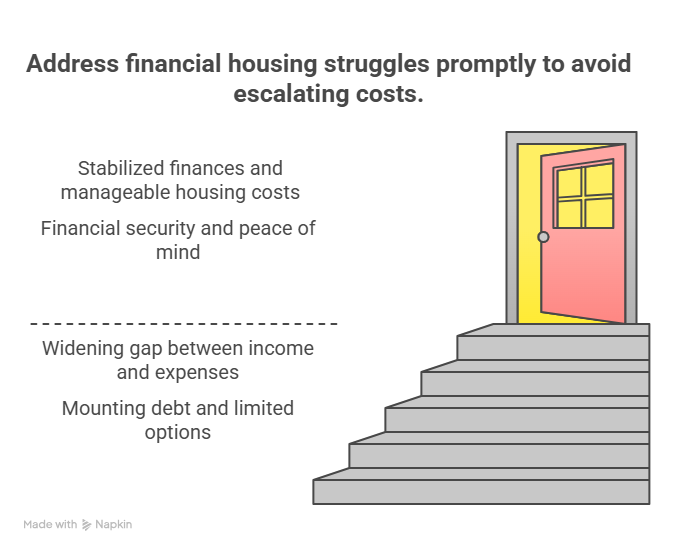
The gap between income and expenses doesn't stay constant—it widens as interest compounds and deferred problems multiply.
What Delay Costs You
1. Depleted Savings
You had $12,000 in reserves when you first realized the house was tight. "I'll give it six months," you thought.
Six months later: $6,000 remaining. Twelve months later: $800 remaining.
If you'd acted at month 1, you'd have $12,000 to cushion your transition. At month 12, you have almost nothing.
2. Accumulated Debt
Using credit to bridge gaps creates new problems:
-
Credit card debt at 24% interest
-
Payday loans at 400% APR
-
Delayed bills with penalties
Each month of delay adds to the pile. Within 18 months, some homeowners accumulate $15,000-$25,000 in high-interest debt trying to save a house they couldn't afford.
3. Deferred Maintenance
That small roof leak becomes major water damage. That minor foundation crack becomes structural failure. That aging HVAC limps along until it dies mid-summer, requiring emergency financing at predatory rates.
Deferred maintenance doesn't pause. It compounds. What could have been fixed for $500 becomes $5,000. What could have been replaced for $5,000 becomes $12,000 plus damage repair.
4. Lost Equity
Every month you wait while behind on payments:
-
Late fees accumulate
-
Property value may decline from deferred maintenance
-
Legal fees might begin if foreclosure starts
-
Your equity evaporates
A homeowner who had $25,000 in equity at month 1 of struggling might have $8,000 by month 18—or zero by month 24 if foreclosure completes.
5. Credit Damage
The longer you wait to address late payments, the worse your credit becomes:
-
One 30-day late: 50-100 point drop, recoverable
-
Multiple 30-day lates: 100-150 point drop, harder recovery
-
60-day late: 120-170 point drop
-
90-day late + foreclosure proceedings: 200-300 point drop
Early action limits damage. Delay maximizes it.
The Psychological Cost
Beyond dollars, delay costs you:
Mental Health: Constant anxiety. Sleepless nights. Stress-related health problems that require medical intervention.
Physical Health: High blood pressure. Digestive issues. Weakened immune system. Chronic stress literally makes you sick.
Relationships: Money stress destroys partnerships. Arguments become constant. Resentment builds. Divorce rates spike under financial pressure.
Opportunities: You can't take career risks, relocate for better jobs, or invest in yourself when trapped in an unaffordable house.
How much life are you losing while waiting?
Real Timelines, Real Costs
Case Study: The Waiter
Homeowner in Garland knew at month 3 that the house didn't fit his budget. Waited 24 months hoping things would improve.
Costs of waiting:
-
Credit card debt accumulated: $16,400
-
Interest paid: $3,800
-
Savings depleted: $9,200
-
Deferred maintenance that compounded: $8,500
-
Late fees on missed payments: $2,100
-
Equity lost between month 3 and month 27: $14,000
-
Total cost of delay: $54,000
When he finally called Bob McCranie at HomeSmart Stars, we sold his home. After paying off debt and fees, he walked away with $3,200.
If he'd called at month 3, he would have walked away with $57,200.
The delay cost him $54,000.
Case Study: The Actor
Homeowner in Lewisville realized at month 2 the house was unaffordable. Called immediately.
We listed at day 45. Sold at day 71. She netted $18,400 after all costs. She moved to a rental $600/month cheaper. Within 18 months, she'd rebuilt $13,000 in savings.
The difference between these two homeowners? Timing of action.
Why People Wait
Fear: "What if I make the wrong decision?"
But not deciding is a decision. It's deciding to let circumstances decide for you, which is usually the worst decision.
Paralysis: "I don't know what to do, so I'll do nothing."
Doing nothing guarantees the worst outcome. Even an imperfect action is better than perfect inaction.
Denial: "Maybe it'll get better."
Hope isn't a strategy. Without concrete changes, nothing improves.
Shame: "I don't want to admit I can't afford it."
Your pride is expensive. Is it worth $20,000? $50,000? Your health?
Misunderstanding: "I don't have options."
You have options until you don't. But options disappear with time.
The Gap That Closes Fast
You think you have time. But the gap between "this is manageable" and "I'm in foreclosure" closes faster than you expect.
Bob McCranie, who's been in Dallas TX real estate since 2003, sees this constantly: "Homeowners call me at day 150 thinking they still have six months. They don't. At 150 days, foreclosure is weeks away, not months. The people who call at day 30 have options. The ones who wait until day 150 have emergencies."
Through over 1561 team sales at HomeSmart Stars, the pattern is consistent: early action preserves options, delay destroys them.
What Waiting Actually Looks Like
Month 1: This is tight, but I can make it work. Month 3: Okay, this is harder than I thought. Maybe next month. Month 6: I'm using credit cards, but I'll catch up soon. Month 9: My savings are gone, but something will change. Month 12: I'm one emergency from disaster, but I've made it this far. Month 15: I missed a payment, but I'll catch up next month. Month 18: I'm three payments behind. How did this happen? Month 21: Foreclosure notice. Now what?
This is how delay works. Slowly, then suddenly.
The Decision You're Avoiding
You already know what you need to do. You've known for months.
The house doesn't fit your financial life. The math doesn't work. You're slowly drowning.
But admitting that feels like failure. So you wait. And waiting costs you everything the admission would have saved.
Your 48-Hour Action Plan
Hour 0-8: Get brutally honest about your numbers. What's your real financial position? How much are you short monthly? How much debt have you accumulated waiting?
Hour 9-16: Calculate the cost of continuing. If nothing changes, where will you be in 6 months? 12 months? 24 months?
Hour 17-24: Assess your equity. If you sold today, what would you net? Compare that to what you'll net if you wait another 6-12 months while accumulating costs.
Hour 25-48: Make a decision. Call your lender about modification. Call Bob McCranie about strategic sale. Do something. Anything. But stop waiting.
The Bottom Line
Delay doesn't make problems disappear. It makes them more expensive and harder to solve.
Every day you wait while financially struggling:
-
Costs accumulate
-
Options narrow
-
Equity erodes
-
Credit damage worsens
-
Recovery gets harder
Home values in Dallas TX remain relatively stable. If you have equity today, you might not have equity in six months if you're accumulating late fees, deferred maintenance, and debt.
The homeowners who thrive aren't those who never struggle. They're those who act when they recognize struggle—before struggle becomes catastrophe.
Waiting for perfect clarity is waiting for a crisis to make your decisions for you.
Stop waiting. Start acting. Your financial future depends on what you do in the next 48 hours, not the next 48 days.
The cost of waiting is too high. The benefit of acting is too great.
What are you waiting for?
Contact Bob McCranie at HomeSmart Stars | 972-754-0582 | www.TexasPrideRealty.com for a FREE 2026 Market Strategy Session