Dallas-Fort Worth Leads the Texas Relocation Surge
America's pandemic-era relocation boom has cooled. Interstate migration fell to its lowest level in a decade in 2024, with just 7.15 million Americans moving across state lines — more than a million fewer than at its 2022 peak. But Texas is still the number one destination for domestic migration in the country, and nowhere in the Lone Star State is feeling that momentum more than the Dallas-Fort Worth metroplex.
A new report from Storage Cafe confirms what DFW real estate professionals already know: relocating households from California, New York, Illinois, and Colorado are landing in Dallas County, Collin County, Denton County, and Tarrant County in steady numbers, drawn by jobs, infrastructure, affordability relative to coastal markets, and one of the most diverse suburban landscapes in the nation.
Why Dallas-Fort Worth keeps winning
The DFW metroplex offers something most major metros cannot: genuine variety at scale. Whether a relocating family wants the energy of urban Dallas, the master-planned polish of Frisco, the lakeside charm of Highland Village, or the wide-open feel of Argyle, the answer is within the same commuter footprint. Top-rated school districts, a booming corporate base, no state income tax, and a cost of living that still undercuts most coastal cities by a meaningful margin keep DFW at the top of relocation shortlists nationwide.
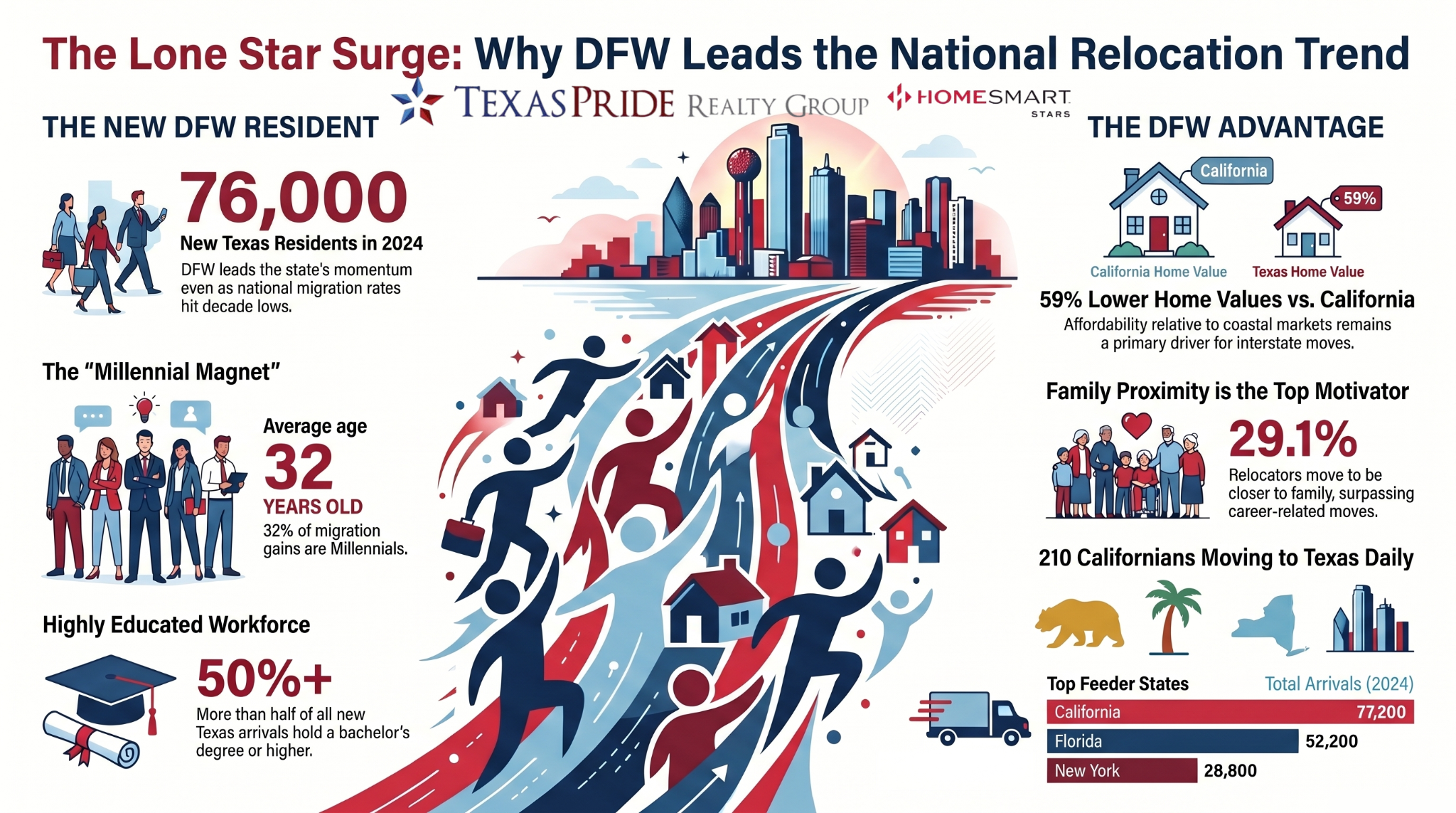
California continues to be the largest feeder state for Texas overall, with about 77,200 arrivals in 2024 alone. Florida sent roughly 52,200, followed by New York at 28,800, Colorado at 24,400, and Illinois at 23,000. Many of those households are heading straight to the DFW suburbs, where job opportunities in technology, finance, healthcare, and logistics are abundant and housing remains comparatively attainable.
Explore DFW homes and communities
From Highland Park to Aubrey, the DFW market covers an enormous range of lifestyles, price points, and community feels. Browse by city or county below.
Who is moving to DFW — and what are they buying?
The profile of the typical DFW newcomer has shifted. More than half of all new Texas arrivals hold a bachelor's degree or higher, and the average age is just 32. Millennials account for 32% of net domestic migration gains, Gen X'ers 24%, and Gen Z'ers 14%. These are career-focused households in their prime earning and family-formation years, and they are reshaping demand across DFW's suburbs — particularly in communities with strong school districts like Frisco, Allen, and Flower Mound.
Only about 39% of new arrivals purchase a home within their first year, with elevated mortgage rates and rising values prompting many to rent first. But demand for ownership remains strong in DFW, where prices — while up significantly over the past decade — still compare favorably to the markets these newcomers left behind. Those considering a move can explore luxury listings, urban lofts, and craftsman-style homes across the metroplex.
What is slowing the pace?
Even DFW is not immune to the broader forces tapping the brakes on relocation. Mortgage-rate lock-in is keeping many would-be sellers — and therefore would-be movers — in place. Millions of homeowners who secured ultra-low rates several years ago are reluctant to trade them for today's higher payments. Remote work rollbacks have also reduced the incentive for long-distance moves, with "new job or transfer" accounting for just 25.9% of all relocations in 2025, down from a 2018 peak of 47.6%.
In its place, family proximity has become the leading reason people move. In 2025, 29.1% of relocators cited being closer to family as their primary motivation, up from 27.1% in 2023. For Texas, and for DFW in particular, that is actually a tailwind — many early pandemic movers who landed here are now drawing parents, siblings, and adult children behind them.
"Moving across state lines is no longer an obvious path to saving money. Relocation decisions are increasingly shaped by pragmatic and lifestyle-oriented considerations — strengthening family ties, planning retirement, or seeking stability amid economic uncertainty." — Storage Cafe
Buying or relocating elsewhere in Texas?
DFW is the headline, but Texas is a big state. If you are weighing other markets — or helping a relocating client explore all their options — browse homes and market data across Houston, Austin, and East Texas below.
Texas remains the destination of choice whether you are chasing career opportunity in Frisco, a walkable neighborhood in Montrose, a growing suburb near Round Rock, or the wide-open pace of East Texas. The Lone Star State still has more room — and more reasons to stay — than just about anywhere else in the country.